Demographic Shifts and Aging in Ecuador: Health Challenges and Policy Opportunities
- Posted by Daniel Sanchez Pazmiño, Odalis Clemente
- -
- 05-09-2025
- -
- Areas: Demography
Manuscript title: Demographic Shifts and Aging in the Middle of the World: Health Challenges and Policy Opportunities in Ecuador
Researchers: Marco Faytong-Haro,Alonso Quijano-Ruiz, Daniel Sanchez -Pazmiño,
Sebastian Salazar-Nicholls,
Andrea X. Gomez Ayora,
Dayana Tipan Jimenez,
Omar Galárraga,
Alexis R. Santos-Lozada
Journal and publisher: The Gerontologist, Oxford Academic
Manuscript link: https://doi.org/10.1093/geront/gnaf176
Ecuador is undergoing a significant demographic transition marked by increased longevity and declining fertility rates. The percent of population aged 65+ is projected to increase from 7.84% in 2022 to nearly 18% by 2050, which entails critical challenges that must be addressed through social and policy solutions. In this paper, we review the state of gerontological research and the institutional context. We discover that gaps remain in several areas, and data availability further complicates future research and evidence-based policy. Moreover, we outline the functional limitations experienced by older adults, proposing structural reforms to key policy areas to better meet the needs of Ecuador’s aging population.
Policy issue
As Ecuador approaches a phase of accelerated population aging, several key policy issues demand urgent attention.
- Preserving and protecting the rights of older adults: The Ecuadorian Constitution recognizes specific rights for older adults, including universal healthcare, labor force participation, retirement, housing access, among others. Any constitutional or legal reform process should be monitored to prevent the erosion of those protections and to ensure they translate into enforceable programs.
- Capitalizing on the demographic dividend: Ecuador currently has more workers and fewer dependents per worker, a temporary advantage known as the demographic dividend. Public policies should accompany this structural benefit, such as strategic investments in education, prioritizing vocational and specialized training aligned with the country’s shifting demographics and emerging industries.
- Caregiving: Family caregiving in the country constitutes the main source of support for older adults, as opposed to a robust institutional care net. Caregiving mostly burdens women: spouses or daughters. As the country ages, the caregiving infrastructure must be one of several areas to be tackled by policymakers.
- Social safety net: The Ecuadorian Institute of Social Security (IESS) is tasked with protecting the population covered by social security through formal employment, as well as their dependent family members, against illness, unemployment, old age, etc. Ongoing discussions have posited that the current system is unsustainable in the long term, with current actuarial evaluations determining that increased government support is needed. We propose an increased attention to the system’s present and future needs, thereby ensuring current and expanded coverage and increased benefits for the Ecuadorian population.
- Public policies for older adults: Two major public programs exist in the country which are aimed at addressing living conditions and needs of older adults: the Bono de Desarrollo Humano (Human Development Bonus - BDH) and Pension Mis Mejor Años (My Better Years Pension - PMMA). While some positive evidence exists for the impact of the BDH, we believe that more robust impact evaluation is needed to better comprehend the effects of these programs.
Gerontological research in Ecuador
We find that existing gerontological research in Ecuador is heavily concentrated on biomedical topics, especially cardiovascular and cognitive health, while areas such as mental health, cultural dimensions, socioeconomic inequalities, and the lived experiences of indigenous communities remain largely neglected.
Regarding data, the study determines two main issues that are blocking progress: (1) no national longitudinal data on aging, and (2) only pre-2020 waves in the main national surveys. The National Health and Nutrition Survey (ENSANUT, 2018) and the Survey on Health, Wellbeing, and Aging (SABE, 2009) are significantly outdated, emphasizing the need for a coordinated effort to produce timelier data on older adults. Without updated information, researchers cannot adequately capture post-COVID changes or track life-course dynamics.
Local evidence from national surveys and a long-running rural cohort (the Atahualpa Project) already points where aging takes the hardest toll: cardiovascular disease, metabolic syndrome, dementia, and falls. Further, researchers have found that indigenous and rural older adults are most at risk. The policy takeaway is clear: invest in prevention-first primary care for adults aged 65+, expand nutrition and fall-prevention programs,introduce culturally appropriate dementia screening, direct resources to high-risk groups, and establish regular, linked data systems to track results and adjust strategies.
Conclusions
Ecuador faces challenges posed by its aging population, as well as considerable research gaps that can allow policymakers better tackle these issues in an evidence-based approach.
The policy challenge is multifaceted: protect the rights and well-being of today’s older adults while using the current demographic dividend to foster economic growth, investing in the human capital of younger generations, and widen the coverage of the social safety net.
We find a sparse yet vivid literature on a number of issues, however, the field lacks depth on critical dimensions. Coordination efforts could significantly improve gerontological research by fostering data access and linkage to better understand critical aspects that currently remain unexplored, such as longitudinal dynamics and post-COVID effects.
The rapid demographic transition offers Ecuador a narrow but critical window to translate demographic advantages into lasting gains. This can be possible only through coordinated action grounded in transparency, rigorous evidence, and sustained public policy commitment.
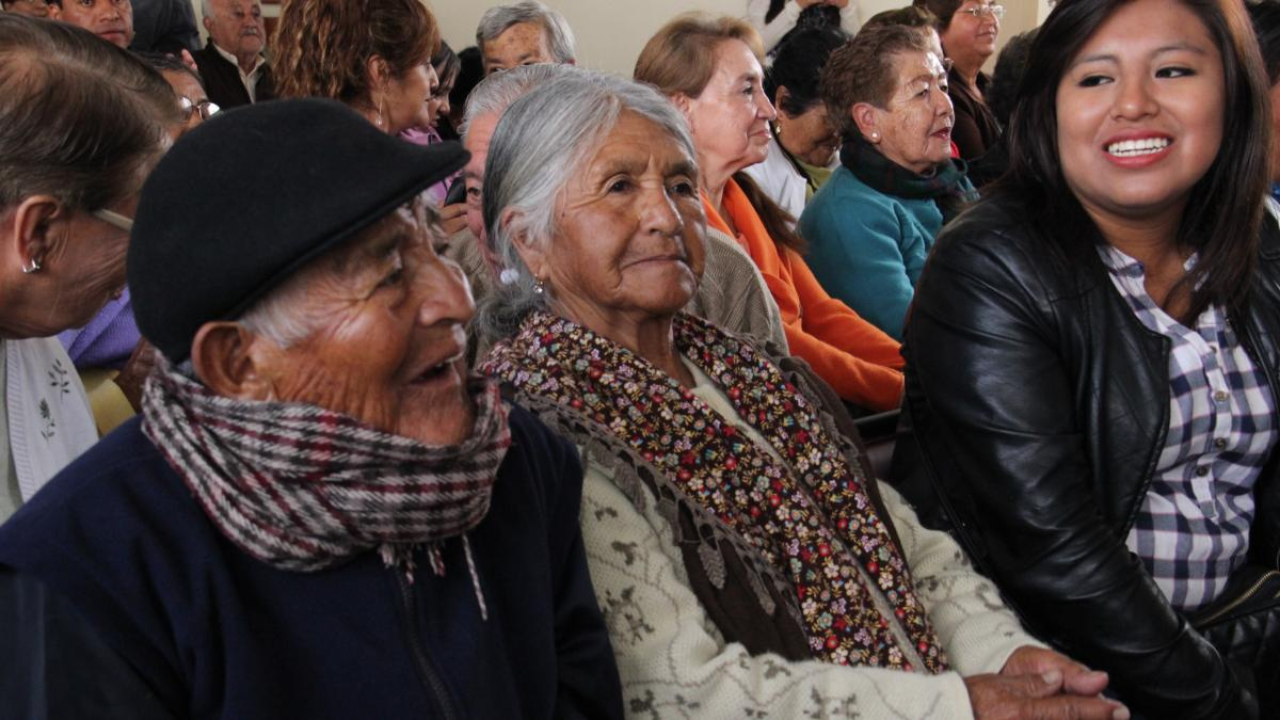
Image: Ministerio de Salud Pública - Ecuador.